ChangeMyFile.com
A browser-based file conversion platform supporting 500+ formats — built from scratch, shipped, and still run by NagoriTech. No installs, no accounts, no friction.
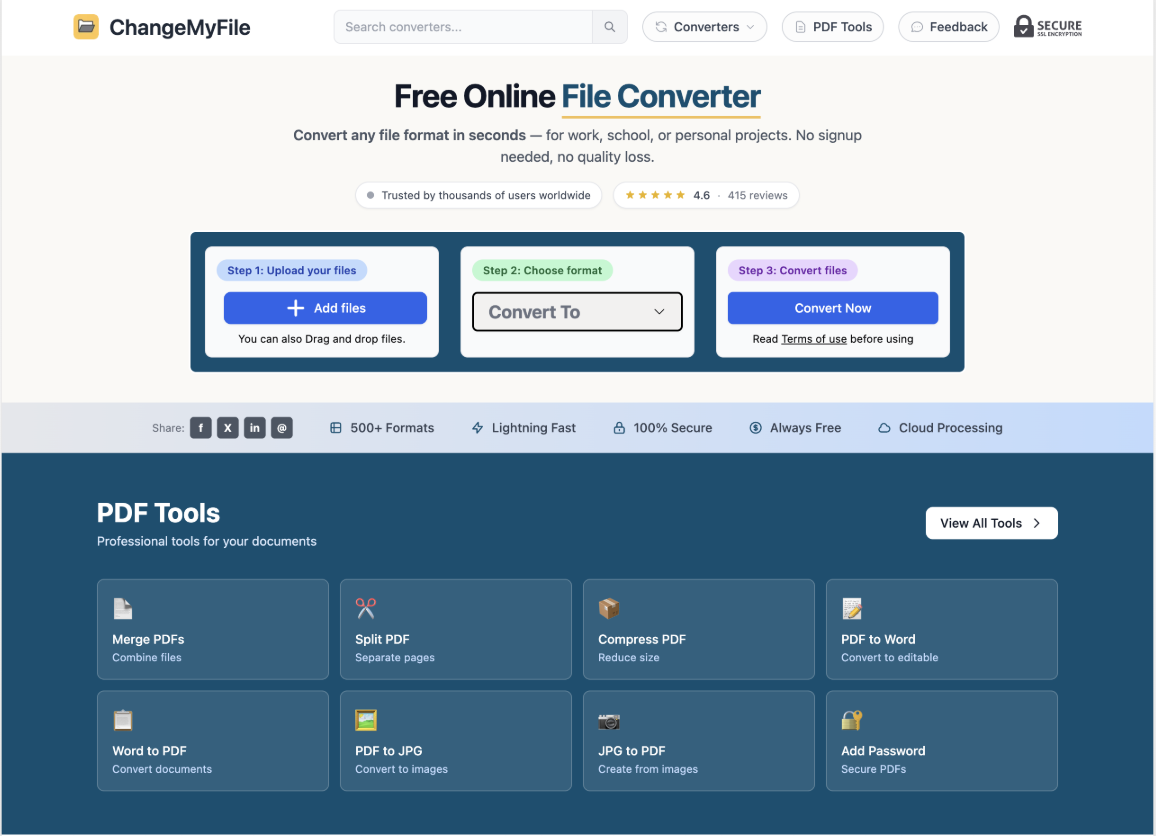
Converting one file should not cost you an install or an inbox.
Someone with one file to convert is not looking for software. They are a student with a document in the wrong format, a professional with a video that will not upload, someone who needs a PDF split before a deadline. The job is small, urgent and one-off — and the usual answers are a desktop install they will use once, or a site that wants an account before it will do anything.
The second problem is trust. Converting a file means handing a stranger your file. Anyone converting a contract, an ID scan or an unreleased edit is right to hesitate, and most tools answer that with a privacy policy nobody reads.
ChangeMyFile answers both directly: it runs in the browser with no account and no install, and files are encrypted in transit and automatically deleted within 24 hours. No retention, nothing to opt out of later.
- →Students converting coursework between formats
- →Professionals fixing a document, image, audio or video file
- →Anyone who wants the job done without installing software
Six decisions that shaped the build.
A stack list tells you nothing. These are the calls we made and what each one cost or bought us.
No account — so everything else had to carry the product
Most converters ask you to sign up before you have converted anything. We took the opposite bet: a first-time visitor drags a file in and gets a result without typing an email address. That removes the easiest lever for bringing people back, so format coverage, speed and clarity have to do the work on their own.
FastAPI, because a conversion spends most of its life waiting
A conversion request is not CPU-bound in the API layer — it waits on an upload, then on a converter process, then on a download. Async handling in FastAPI lets one Python service hold many in-flight jobs at once and stream progress back to the browser, rather than tying up a worker per file.
Docker, because conversion means running binaries we did not write
Covering 500+ format pairs across documents, images, audio and video means shelling out to third-party conversion tools — each with its own system dependencies and its own reaction to malformed input. Containers keep those tools pinned, reproducible and boxed off from the host, and the image that runs locally is the image that runs on the server.
Auto-deletion in 24 hours is an architecture, not a checkbox
Promising files disappear within a day makes storage a buffer instead of a library. Every upload carries an expiry from the moment it lands, nothing is built to be recalled later, and with no accounts there is no file history to attach anything to. It also keeps the privacy promise short enough to state in one sentence.
Server-rendered front end, because tools are found through search
Next.js renders the pages on the server, so what reaches a crawler is real HTML rather than an empty shell — while the converter still behaves like an app once it is in the browser, with drag-and-drop and live progress.
A deploy pipeline, because we are the ones on the hook
We own this product, which means we own every regression in it. Deploys run through GitHub Actions rather than by hand, so shipping a fix on a Tuesday afternoon is a non-event instead of a small ceremony.
The product that came out the other side.
Conversion coverage
- →500+ file format conversions — documents, images, audio, video
- →Batch conversion — up to 5 files simultaneously
PDF toolkit
- →Merge, split and compress PDFs
- →Password protection on the way out
Zero-friction interface
- →No account required — nothing to sign up for
- →Drag-and-drop with real-time progress updates
- →Fully responsive — works on any device and OS
Privacy by default
- →SSL encryption in transit
- →Files auto-deleted within 24 hours
Seven pieces, each earning its place.
Nothing here was chosen because it was fashionable. Each part answers a specific pressure the product puts on it.
Crawlable HTML for a product people find through search, without giving up the app-like upload experience.
Async Python that holds many waiting conversions at once instead of one worker per file.
Every converter binary and its dependencies pinned inside an image, isolated from the host.
The relational store for everything that is not the file itself — the parts that outlive a 24-hour upload.
Sits in front of the app and terminates TLS — the SSL half of the privacy promise.
The machine the whole thing runs on. Deliberately boring, deliberately well-understood.
Build and deploy straight from the repo, so releases are repeatable rather than remembered.
This one is not a client project. It is ours.
Agencies are easy to hire and hard to judge, because most of what they show you is work they walked away from at launch. ChangeMyFile is the opposite: we designed it, built it, deployed it, and we are still the ones running it.
We shipped every layer of it
Product design, frontend, backend API, database schema, server infrastructure, CI/CD and production deployment — all in-house, no handoffs.
It is live, and it is ours
This is not a demo or a client engagement that ended at launch. ChangeMyFile is in production and NagoriTech owns it outright.
We carry the maintenance
There is no client to hand it to. Upgrades, dependency churn, server maintenance and bug reports all land on us — the same thing we take on when we run a product for a client.
The 4.6★ rating and the thousands of people using it are the part we did not get to design. They are what happened after it went live.
Have an idea? Let's build it.
We own the full stack — from wireframe to production, and past it. Tell us what you are building and we will come back with an honest scope.